
Most sketchbooks fall apart the moment you start mixing media. You lay down a watercolor wash, let it dry, come back with acrylic — and the page buckles, tears, or turns into a sodden mess. Mixed media work punishes the wrong paper fast. The best sketchbooks for mixed media need to handle layering without warping, hold wet media without bleeding through, and survive dry techniques on the same surface. This guide cuts through the options and focuses on what actually works for artists who don’t like staying in one lane.
Quick Comparison
| Product Name | Best For | Paper Weight | Binding |
|---|---|---|---|
| Strathmore 400 Series Mixed Media | Best overall | 184 lb | Glue bound |
| Canson XL Mixed Media | Budget workhorse | 98 lb/160 gsm | Wire bound |
| Strathmore 500 Series Heavyweight | Professional finish | 3-ply cotton | Tape bound |
| Stillman & Birn Zeta | Heavy layering | 270 gsm | Wire/hardbound |
| Arteza Mixed Media Pad | Affordable practice | 98 lb/160 gsm | Spiral |
| Moleskine Art Collection | Light mixed media + travel | 200 gsm | Hardbound |
Disclosure: This post may contain affiliate links, which means Pickory may earn a commission at no cost to you.
What to Look for in a Mixed Media Sketchbook
Paper Weight Is Your Foundation
For mixed media, paper weight is the single most important spec. Under 160 gsm and you’ll run into problems fast — pages warp under wet media, buckle with acrylic, and can’t handle the friction of layering dry pigments on top. For light mixed media (watercolor pencil, light ink washes, colored pencil) aim for 160 gsm minimum. For heavier work involving acrylic, collage, or repeated wet layers, 200 gsm and above is where you want to be. If you’re new to choosing paper weights, our guide to the best sketchbooks for beginners covers the basics of what GSM means in practice.
Surface Texture Determines What You Can Layer
Mixed media artists need a surface that can grip both wet and dry pigments without fighting either. Too smooth and dry media like charcoal or pastel won’t adhere well. Too textured and fine-detail ink work becomes frustrating. The sweet spot is a medium-grain or fine-texture surface with good sizing — the internal treatment that controls how much ink and water the paper absorbs. A well-sized paper lets you build layers without earlier layers reactivating or bleeding.
Graphite pencil is one of the most common dry media used in mixed media work — if you’re also choosing pencils, our guide to the best graphite pencil sets for sketching covers which grades work best for layering.
Binding Affects How You Work
Spiral and wire-bound pads lay flat, which matters when you’re working across a spread or pressing hard with dry media. Glue-top pads are compact but pages can tear unevenly on removal. Hardbound sketchbooks feel more archival and are great for finished work, but check the paper specs carefully — many hardbound books marketed as mixed media don’t have paper heavy enough for serious wet media use. For artists who work on the go, our best sketchbooks for travel covers which binding types hold up best in the field.
Bleed-Through vs. Bleed Resistance
Most mixed media papers are not fully bleedproof — and that’s intentional. Unlike marker paper, mixed media paper is designed to absorb some of the media so layers bond properly. What matters is that ink and paint don’t soak straight through to the next page. A good mixed media pad should handle 10–15 layers before any show-through, and acrylic or heavy ink should stay on the working side without wicking to the back.
Strathmore 400 Series Mixed Media Pad — Best Overall
The Strathmore 400 Series Mixed Media Pad is the most versatile pick for artists who want one pad that handles everything. The 184 lb paper has a vellum finish that’s smooth enough for detailed pencil and ink work, while the internal sizing keeps watercolor and acrylic on the surface long enough to manipulate before soaking in. It handles repeated wet layers without buckling, and the glue-bound format removes pages cleanly for scanning or framing. This is the pad that artists across skill levels keep coming back to.
Pros:
- 184 lb paper handles both heavy wet and dry media reliably
- Vellum finish suits pencil, ink, colored pencil and wet media on the same sheet
- Glue-bound with clean page removal, available in multiple sizes
Cons:
- Glue-top binding means no easy lay-flat for wide spreads
- Not cotton — for archival-grade work the 500 Series is worth the step up
Canson XL Mixed Media Pad — Best Budget Workhorse
The Canson XL Mixed Media Pad is a staple in art classrooms and studio practice pads for good reason. The 98 lb/160 gsm fine-textured paper handles light watercolor washes, ink, acrylic, colored pencil, and collage without falling apart. It’s wire-bound with micro-perforated pages for clean removal, and comes in enough size options to suit most working styles. At its price point it’s hard to find a pad that handles this range of media reliably. Perfect for experimentation and working out ideas before moving to more expensive paper.
Pros:
- Handles a wide range of media at an accessible price
- Wire bound with micro-perforated pages for clean removal
- Available in multiple sizes with good sheet counts
Cons:
- 160 gsm shows some buckling under very heavy wet media or repeated acrylic layers
- Not suitable for serious collage or heavy impasto work
Strathmore 500 Series Heavyweight Mixed Media — Best for Professional Work
When the quality of the surface matters as much as the work itself, the Strathmore 500 Series is the step up. This is a 3-ply, 100% cotton paper with a vellum finish — the kind of surface that handles watercolor, gouache, acrylic, ink, pastel, colored pencil, and collage across multiple heavy layers without compromising. Artists who have moved past student-grade paper and want a pad that performs like individual fine art sheets report a noticeable difference in how media behaves, how layers build, and how finished work looks. It’s archival, lignin-free, and genuinely worth the price for finished pieces.
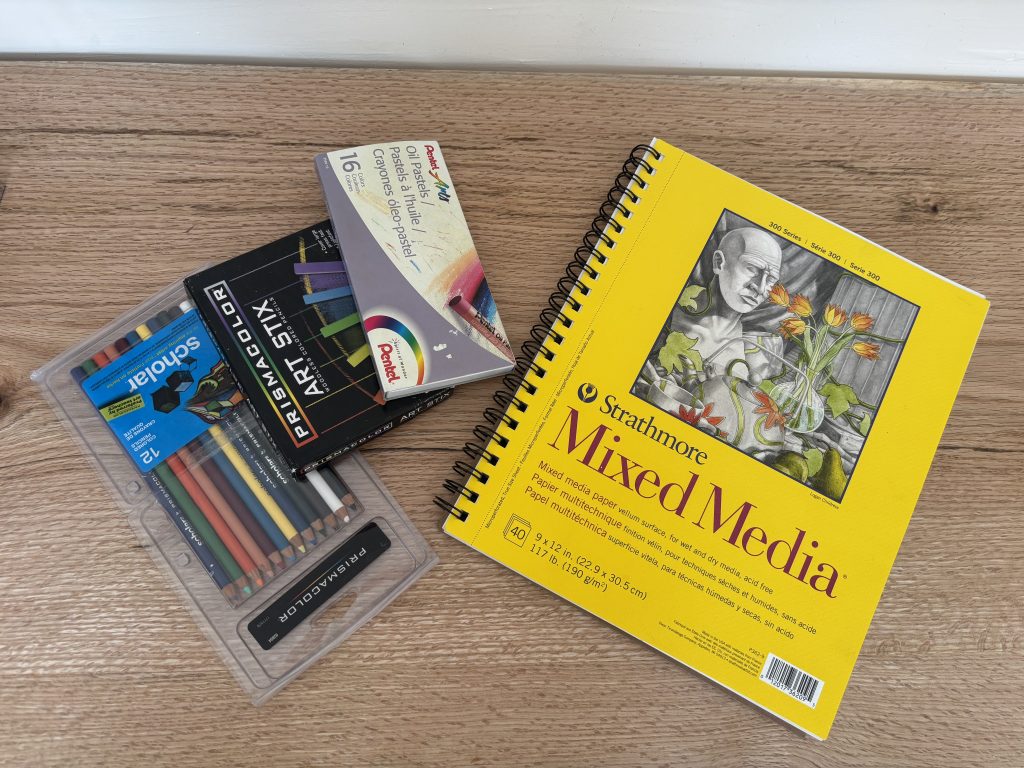
This is also the sketchbook I personally use for my mixed media work. I’ve tested it with acrylic, ink, and light collage, and it holds up without warping or bleeding through. The paper has enough weight (184 gsm) to handle layering, but still feels easy and approachable for everyday use. If you’re looking for one sketchbook that can handle a range of materials, this is the one I keep coming back to.
Pros:
- 100% cotton, archival-grade — suitable for finished work and professional illustration
- Handles repeated wet layers, scrubbing and erasing without surface breakdown
- Vellum finish works for both precise line work and expressive wet techniques
Cons:
- Higher price point and lower sheet count than student-grade options
- For pure watercolor with heavy texture, cold-press watercolor paper is still better
Stillman & Birn Zeta Series — Best for Heavy Layering
The Stillman & Birn Zeta is beloved by illustrators and mixed media artists for its unusual combination of a smooth, Bristol-like surface and 270 gsm weight. That smoothness makes it exceptional for ink, markers, and fine pen work, while the weight handles light watercolor and repeated media applications without warping. The hardbound construction is built to last, and the sewn binding allows pages to lay completely flat — a meaningful advantage when working across large areas. If your mixed media work leans toward ink-heavy techniques with watercolor accents, the Zeta is hard to beat.
Pros:
- 270 gsm extra-heavyweight paper handles layered mixed media without buckling
- Smooth surface is exceptional for ink, fountain pen, and marker work
- Sturdy hardbound construction with sewn binding that lays flat
Cons:
- Smooth surface is less suited to dry media like charcoal or soft pastel
- Premium price per sheet compared to pad options
Arteza Mixed Media Pad — Best for Affordable Practice
Arteza has built a solid reputation for delivering reliable quality at student-friendly prices, and their mixed media pad is no exception. The 160 gsm paper handles the basics — watercolor, ink, colored pencil, light acrylic — without the page count anxiety that comes with more expensive pads. Spiral-bound with perforated pages, it’s a solid daily practice pad for artists who want to experiment freely without worrying about the cost per sheet. A good choice for building mixed media skills before graduating to pricier paper.
Pros:
- Affordable price per sheet makes it genuinely good for daily practice
- Handles light to moderate mixed media techniques without falling apart
- Spiral binding lays flat for comfortable working
Cons:
- Not suited for heavy acrylic or collage — paper starts to buckle under aggressive wet media
- Thinner feel than Strathmore or Canson equivalent weights suggest
Moleskine Art Collection Mixed Media — Best for Light Mixed Media and Travel
The Moleskine Art Collection sketchbook brings its signature portable, hardbound format to mixed media. The 200 gsm paper handles light watercolor, ink, and acrylic without the warping you’d expect from a bound book at this size. It’s not built for aggressive layering — collage and heavy acrylic will push it past its limits — but for artists who work with lighter mixed media techniques and want something that feels polished and portable, it earns its place. Particularly useful for travel sketching where you’re combining watercolor with pen and ink. See how it compares to dedicated travel options in our best sketchbooks for travel guide.
Pros:
- 200 gsm paper handles light mixed media including watercolor and ink
- Durable hardbound format protects pages in bags and on the go
- Compact and lightweight for travel use
Cons:
- Not built for heavy layering, collage, or repeated acrylic applications
- Higher price per sheet than most pads at the same performance level
Frequently Asked Questions
What paper weight do I need for mixed media?
For mixed media work, 160 gsm is the minimum you should use — anything lighter will buckle under wet media and struggle with layering. If your work involves acrylic, heavy watercolor washes, or collage, aim for 200 gsm and above. For professional finished work, cotton-based papers in the 270 gsm range like the Stillman & Birn Zeta or Strathmore 500 Series are worth the investment. Paper weight matters more for mixed media than almost any other medium because you’re asking one surface to handle multiple demands.
Can you use watercolor in a mixed media sketchbook?
Yes — most mixed media sketchbooks are designed to handle light to moderate watercolor washes. The key is the paper’s sizing, which controls how water and pigment absorb into the surface. A well-sized mixed media paper lets watercolor sit on top long enough to manipulate before it sinks in. For heavy wet-on-wet watercolor techniques, a dedicated watercolor pad with 300 gsm cold-press paper will still outperform a mixed media pad — but for combining watercolor with other media, a quality mixed media pad handles it well.
What’s the difference between mixed media and multi-media sketchbooks?
The terms are used interchangeably by most manufacturers. Both refer to paper designed to handle a combination of wet and dry media on the same surface. The distinction that actually matters is the paper weight, surface texture, and whether the paper is wood-pulp or cotton-based — not the label. When comparing sketchbooks, focus on GSM, surface finish, and whether the paper is sized for wet media rather than whether it says “mixed media” or “multimedia” on the cover.
Final Verdict
The Strathmore 400 Series Mixed Media Pad is the best overall pick for most artists — it handles the widest range of media reliably, comes in multiple sizes, and hits a price point that makes regular use practical. For budget practice, the Canson XL Mixed Media is hard to argue with — it punches above its price on most techniques. When quality is the priority and you’re working on finished pieces, the Strathmore 500 Series Heavyweight is worth every penny. Check current prices before buying as availability and deals change frequently.
Leave a Reply